


JEWELRY INVESTMENT FOR CASTING
F000516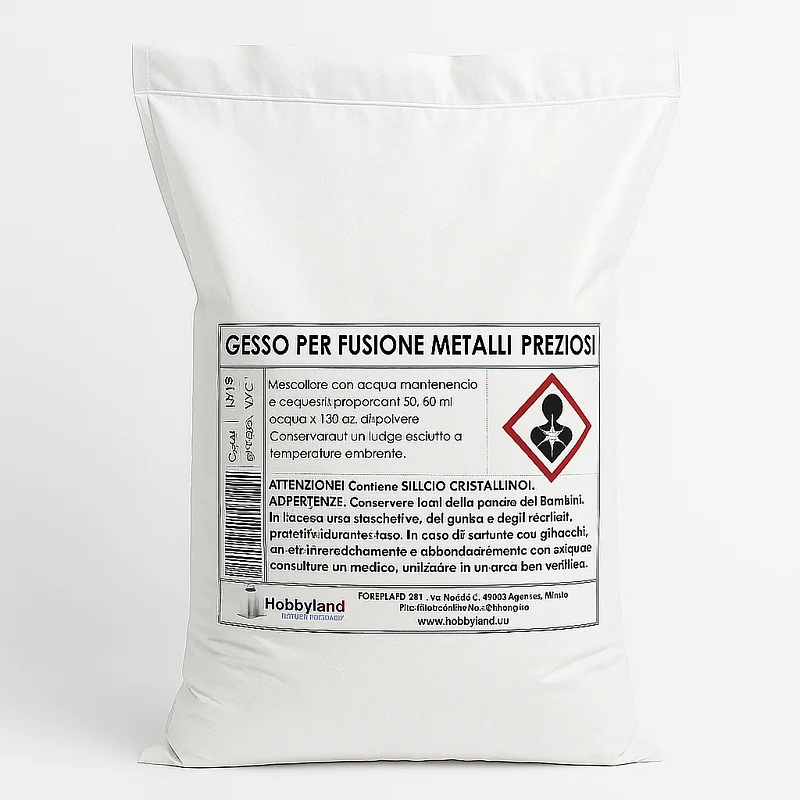
Filters
PACKAGING|
PACKAGING |
PRICE | Q.TY | ||
|---|---|---|---|---|
|
1 KG |
€ 9,50
€ 7,79 ex VAT |
||
|
|
22,68 KG |
€ 129,50
€ 106,15 ex VAT |
Other items in the category
Frequently bought together
Detailed description
Refractory plaster for lost-wax microcasting, designed for producing high-definition cylinder molds. Ideal for jewelry, artistic applications, and small foundry work where fine detail, clean surfaces, and dimensional stability are required. The gypsum-based formulation provides excellent flow during pouring and a dense, homogeneous structure after setting, suitable for casting non-ferrous metals with medium melting points.
Key features
High-fidelity reproduction of the original model
Excellent flowability and ease of preparation
Smooth, well-defined mold surfaces
Compact and uniform structure after setting
Suitable for manual and professional processes
Technical specifications
Application: lost-wax microcasting in cylinders
Type: gypsum-based refractory investment
Typical items: jewelry, medals, coins, thin technical parts, prototypes
Castable metals: gold (all karats), silver, precious alloys, low-temperature zinc-based alloys
Not suitable for: bronze, brass, copper, steels, high-temperature alloys
How to use
This casting plaster is designed for creating investment molds for lost wax microcasting, suitable for casting precious metals and low-temperature alloys.
Mix preparation
Use clean, preferably demineralized water at room temperature. Recommended ratio: 38–40 parts water to 100 parts powder. Always add the powder to the water, never the reverse, and mix first by hand and then with an electric mixer until a smooth, fluid and homogeneous mixture is obtained.
Pouring into the flask
Place the wax model inside the flask and proceed with pouring the plaster following one of the methods described below.
Use with vacuum pump (recommended)
After mixing, degas the compound under vacuum to remove trapped air. Slowly pour the plaster into the flask and perform a second short vacuum cycle on the filled flask to eliminate residual air bubbles around the model. Remove from vacuum and allow to set completely.
Use without vacuum pump
Mix at moderate speed to limit air entrapment. Let the mixture rest briefly after mixing, then pour slowly into the flask in a thin, continuous stream along the inner wall. Gently vibrate the flask to help air bubbles escape and allow to fully set before firing.
Setting time
After pouring, the flask must remain stable until the plaster has completely set. A minimum resting time of 1 hour is recommended before handling.
Preheating
Preheating is essential to gradually remove residual moisture and avoid thermal shock. Place the flask in a cold furnace, slowly raise the temperature to 100–120 °C and hold for at least 3–4 hours depending on flask size. Skipping this step may cause cracks or mold failure.
Burnout firing
After preheating, proceed with a gradual firing cycle to completely eliminate the wax model and stabilize the mold. The maximum firing temperature is suitable for precious metal casting and must be reached progressively, with possible intermediate holds.
Metal casting
At the end of firing, the flask is brought to the appropriate casting temperature for the selected metal (gold, silver or equivalent alloys). Casting can be performed using centrifugal machines, vacuum casting systems or suitable manual microcasting methods. Correct mold temperature ensures full filling and improved surface finish.
Note
Use only with compatible metals. Not suitable for bronze, brass, copper or high-temperature alloys. Store in a dry, tightly sealed place.